02/19: Constraints: Audience Understanding (Nat’l Cancer Statistics)

Assigned Today

Your final technical memo proposing a report subject and approach is due this weekend.

Today’s Content

We’ll come back to audience today and think about the function of a document like Jemal et al. (2017) for folks who might not be statisticians.

What is the real function of a document like this? Is it problem-oriented, or does it have some other purpose? How does it support its purpose, and how are audiences supposed to use it?

02/17: Affordances: Graphic Use (Nat’l Cancer Statistics)

Assigned Today

Your last technical memo—the official proposal for your technical report—is due at the end of the week.

Today’s Content

This week’s reading is hard. There is a lot of data in here, and a lot of that data is presented in statistical form. Not all of us are math people. (I’m certainly not.)

So, we’ll focus on what this document seems intended to do, and we’ll look at how the design of its pages, graphics and paragraphs supports that function.

Today’s focus is going to be on the text that goes with the graphics.

02/15: Affordances: Graphic Use (Nat’l Cancer Statistics)

Assigned Today

Your last technical memo—the official proposal for your technical report—is due at the end of the week.

Today’s Content

This week’s reading is hard. There is a lot of data in here, and a lot of that data is presented in statistical form. Not all of us are math people. (I’m certainly not.)

So, we’ll focus on what this document seems intended to do, and we’ll look at how the design of its pages, graphics and paragraphs supports that function.

Today’s focus is going to be on the graphics themselves.

02/12: Constraints: Audience Need (Walkability)

Assigned Today

Before next week, please read “Annual Report to the Nation on the Status of Cancer, 1975–2014, Featuring Survival” (2017) by Jemal et al. (LINK).

Please also read the Open Technical Communication chapter on Page Design (LINK).

Today’s Content

We’ll talk through all of the evidence provided in Adkins et al. (2008). The main question we’ll be asking ourselves is why is this here? Technical documents need to carefully choose the evidence they provide to keep a document as concise as possible. Academic documents tend to have broader audiences, so they must provide broader evidence to meet the needs of all possible readers.

So, we will dive into Adkins et al. (2008) to better understand what the function is of each citation. Audiences won’t always read the entire document we give them, but they will read what they need to (or what they think they need to, based on our signalling) to understand what we’re getting at.

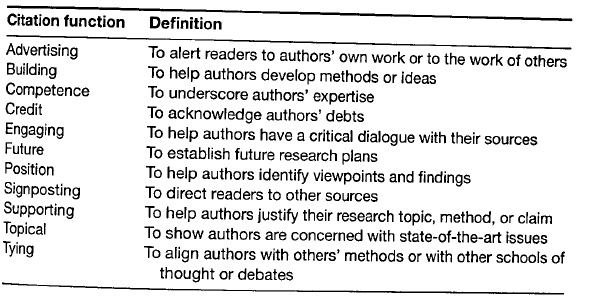
We will use Nigel Harwood’s classifications of citation functions in this conversation:

AdvertisingTo alert readers to authors’ own work or to the work of others
BuildingTo help authors develop methods or ideas
CompetenceTo underscore authors’ expertise
CreditTo acknowledge authors’ debts
EngagingTo help authors have a critical dialogue with their sources
FutureTo establish future research plans
PositionTo help authors identify viewpoints and findings
SignpostingTo direct readers to other sources
SupportingTo help authors justify their research topic, method, or claim
TopicalTo show authors are concerned with state-of-the-art issues
TyingTo align authors with others’ methods or with other schools of thoughts or debates
From N. Harwood (2010) “Research-based materials to demystify academic citation for postgraduates“

we’ll look at the background section and talk about the ways they set some of this up. Today or Friday, we’ll talk through a summary process called a rhetorical precis, which is composed of four sentences:

  1. A description of what the document is (report, article, blog post, video, etc.) and what it DOES (argues, advocates, evaluates, describes, etc.)
  2. A description of how the document gathered or organized its information (its methods section or its supporting background info)
  3. A description of the document’s ultimate purpose or reason for existing
  4. A description of the document’s target audience or ideal user-base

02/10: Affordances: Technical Structures (Walkability)

Assigned Today

Remember that you have a technical memo due this week!

Today’s Content

We’ll keep talking about practices of incorporating evidence into our writing, whether that’s an external cited resource, empirical data we’ve collected or the result of some logic on our own. We’ll look at some common structures we can use in our writing to put together discussions quickly.

We’ll focus in on the Discussion section of Adkins et al. (2008). While the structures they provide are not necessarily universal, they are excellent models to build from in our own work.

Update

We’re getting to a point in the term where it’s handy to have a written form of what we’re getting at in class, particularly on a day like today.

In the discussion section, we’ll look at the authors’ techniques for reporting three kinds of information: (1) things they expected to find, given their background information; (2) things they didn’t find and, likewise, expected to not find, given their background information; and (3), things they did not expect or don’t know how to handle, given their background information.

Assuming we have time, we’ll look at the background section and talk about the ways they set some of this up. Today or Friday, we’ll talk through a summary process called a rhetorical precis, which is composed of four sentences:

  1. A description of what the document is (report, article, blog post, video, etc.) and what it DOES (argues, advocates, evaluates, describes, etc.)
  2. A description of how the document gathered or organized its information (its methods section or its supporting background info)
  3. A description of the document’s ultimate purpose or reason for existing
  4. A description of the document’s target audience or ideal user-base

02/08: Affordances: Citation Practices (Walkability)

Assigned Today

Your fourth technical memo is due at the end of the week.

Today’s Content

We’ll talk through a research process today and look at how that can manifest in writing. This is kind of involved, and I’ll post a video of it when we get to this point in the term. EDIT: This is that video! It’s from last Spring because I haven’t been able to clean out my garage enough to re-do it.

Seriously. My garage is a disaster.

But, for right now, I assume you know how to do these things:

  • Search Wikipedia for information
  • Search the library website (oit.edu/libraries) for resources, and get access to things we have online as full-text or things you need to get a physical copy of
  • Search Google Scholar (https://scholar.google.com) for resources, and get access to more resources by logging in to TechWeb on another tab

In class, we’ll talk through these processes:

  • Citation Mining: Finding a reference inside another useful reference, then tracking it down. This is useful for tracking the history of a conversation.
  • Citation… uhh… whatever the opposite of mining is. Citation farming? Using Google Scholar to track things that have cited a thing you find useful. This is useful for tracking the development of a conversation.
  • Abstract Research: Referencing the core findings or methods of documents based primarily on what they say in their abstracts. This is an ethical gray area. You need to do it well if you’re going to use this citation practice.

02/05: Constraints: Rules vs. Guidelines (Atmospherics)

Assigned Today

Before next week, please read Adkins, Dill, Luhr and Neal’s “Unpacking Walkability: Testing the Influence Urban Design Features on Perceptions of Walking Environment Attractiveness” (LINK).

Please also read the Open Technical Communication chapters on Ethics (LINK) and citation techniques (LINK).

Today’s Content

Michon et al. (2005) is a great reference for talking about your own empirical data. They demonstrate a lot of moves that we can follow, but there are also some choices that are particular to business research and the journal they published their paper in.

So, as a nice midterm “assignment,” today’s discussion is going to bring us back to the start of the term and everything we’ve touched on along the way. We’ll talk about Michon et al., Grounding of the St. Dominick and other documents we’ve seen.

Rules of Technical Writing

What seem to be hard and fast rules of technical writing? That is, what are you allowed to do and not allowed to do when doing this kind of writing?

Guidelines of Technical Writing

What seem to be the things you should be doing in technical writing, but that don’t seem to be required all the time?

Does it seem like there are rules to follow when you decide to do those things?

02/03: Affordances: IMRD (Atmospherics)

Assigned Today

Your third technical memo is due at the end of this week.

Today’s Content

We’ll talk about a common report structure today: IMRD. It’s something you’ve practiced if you’ve been a class with lab reports. It’s also something you’ve probably seen pretty frequently, even if we don’t have the headings named in this pattern (or even if we don’t have headings at all).

Introduction: Provide an overview of your document. Tell the reader its purpose, the reason you did this work in the first place, and any prior research or prior conversations you are building from. The introduction should always begin with something your audience already knows. Use this to build the rest of your conversation by linking each new point back to something previous.

Methods: Sometimes, this is a Procedure, Methodology, Research Design section or something else. But, a methods section should tell the audience how information was gathered or analyzed if they couldn’t safely assume it from your document’s introduction. So, if you’re in a geology lab and you’re testing minerals to see what’s igneous and what’s sedimentary, you’ll probably want to tell your reader what specific lab procedures you went through. But, if you’re in a literature class and you’re telling the reader about the theme of friendship in the Lord of the Rings, we’ll all safely assume that your procedure was “I read a thing and thought about it.”

Results: If your research process found brand new information that the world has never seen (even if it’s something as simple as the results of a survey you sent out), you should report them without any analysis or interpretation. Results sections typically have lots of non-text elements like graphs, tables, pictures and other visual representations of your data.

Discussion: At the end of your document, tell your reader why what you found was important. Connect your data/results back to the purpose of your document (what you said in your introduction). Every hypothesis or problem you intended to discuss should be discussed here. If you are recommending a particular course of action from your reader, your discussion section should make it clear why that action is a good idea. This section should also include any limitations to your work.
02/01: Affordances: Empirical Data (Atmospherics)

Assigned Today

Your third technical memo is due at the end of this week.

Today’s Content

We’re going to talk about the techniques involves in writing about empirical data.

Empirical data is that which has been gathered through direct observation or experience. Data gathered through theory/logic is not empirical. Generally, reporting others’ empirical data doesn’t fall into this category either.

Michon et al. (2005) discuss a lot of data that others gathered, and they use that to explain how they gathered their own and to contextualize the importance of the data they gathered.

We will use their example to discuss the affordances that technical writing gives us when we’re presenting data like this. One of our main questions will be the degree of explanation required from the authors.

Edit on Feb 1: The chart below might be useful for us. It gets at uses of citations, rather than empirical data, but it may help make connections to their data collection methods.

From Nigel Harwood’s “Research-based Materials to Demystify Academic Citation for Postgraduates”
  • Did you understand all of the data they presented to you?
  • Did you understand the analyses they did or the mathematical importance of their findings?
  • Could you understand their findings overall and the importance of them, even if you didn’t understand the math part?

01/29: Constraints: Sticking to your purpose (St. Dominick)

Assigned Today

Over the weekend, please read Michon, Chabet and Turley’s “Mall atmospherics: the interaction effects of the mall environment on
shopping behavior” (LINK)

Please also read the Open Technical Communication chapters on Tables, Charts and Graphs (LINK) and on Graphics (LINK).

Today’s Content

We’ll end our St. Dominick conversation by talking about one of the constraints of a technical report: the effect of declaring a specific scope of your document.

We will also talk about how our expertise—the subject of our memo this week—can affect our ability to declare a purpose in the first place. While technical reports offer us a lot of affordances in terms of limiting how much we need to write, some of these other factors will limit how much we can write, and we’ll need to find a balance between them.

Key takeaways for this week:

  • Technical structures, like report, offer a lot of support in figuring out what we need to write and what we can do with a document
  • Technical structures can also be limiting, in that we need to follow enough of their rules that our document is still recognized as something in that category.
css.php