If you have not already, please sign up for a time slot to talk one on one next week about your draft. These meetings take about 20-30 minutes, but I’m letting everyone reserve the full hour in case we go long (or, more realistically, in case you have a class that runs into that hour).
Mon
Tue
Wed
Thur
Fri
Dylon Y
8-9am
8-9am
8-9am
Tentative: Mariko
Liam B
9-10am
9-10am
In class 9am-10am
Alison M
In class 10-11am
10-11am
In class 10-11am
Ben A
In class 10-11am
Office hours 11am-Noon
Office hours 11am-Noon
Office hours 11am-Noon
Office hours 11am-Noon
Office hours 11am-Noon
Jessica E
In class 12:30-2pm
Noon – 1pm: Zach N
In class 12:30-2pm
Landon M
Kela L
In class 12:30-2pm
1-2pm: Paula H
In class 12:30-2pm
Nick F
2-3pm: Jake W
2-3pm: Adam N
2pm: Emma C
Meeting starting at 2:30
Meeting 2pm-3pm
Meeting 2pm-3pm
3-4pm
3-4pm
3-4pm
3-4pm: Mariko B
Class 3pm-5pm
4-5pm
Kirsten R
4-5pm
4-5pm: McKenna S
Class 3pm-5pm
Please bring the current draft of your technical report to class today. We will work through a few peer review exercises.
I assume you will be reviewing each other’s work in Microsoft Word or in an Open Office Writer product. In Word, you can find Track Changes and Comment tools underneath the Review tab. In Open Office, you will find Track Changes under the Edit menu (Edit > Changes > Record) and Comments under the Insert menu (Insert > Comment).
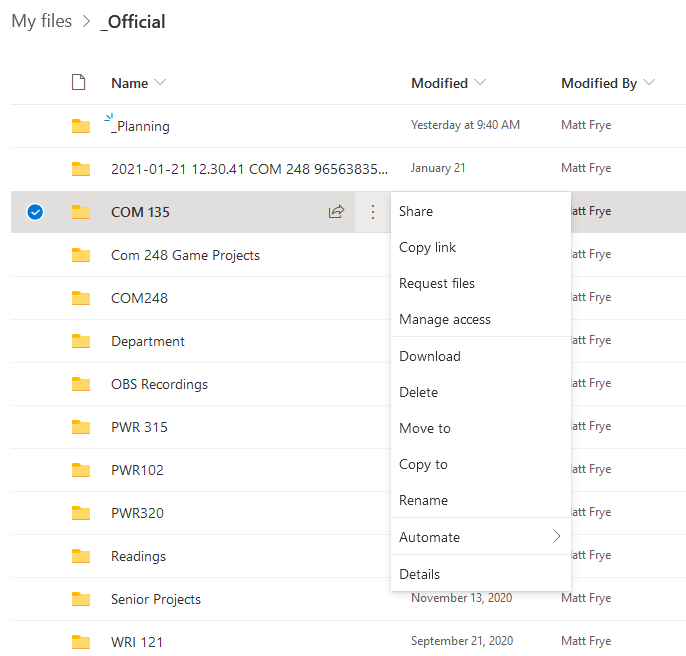
Before we start, if you’re working on Zoom, please make sure your document is saved in your OneDrive folder. If you’re working from office.com, you can click the context menu (three vertical dots), then click “Share” to get a link to send to your peer.
If you are using OneDrive on your computer, simply right click the file you want to share, then click the “Share” option.
Your peer will be able to view this file, unless you set the permissions to allow editing.
If you are nearly complete, you’ll work with folks in a similar stage to double-check and finalize your report before turning it in.
Nearly Complete Peer Review Process
Talk to your partner about your expertise as a writer and the expected expertise of the audience. Explain your report’s purpose. Next, trade OneDrive links or trade physical documents. (There is hand sanitizer in the classroom.)
Read your partner’s document. Wherever you have questions, leave a comment asking that question. This includes jargon clarification, asking for examples or asking genuine questions about the subject.
If you think the target audience would understand, even if you don’t, state that, but still ask your question. Do not assume the target audience automatically understands what’s going on. That assumption has always backfired on me professionally.
In addition to these questions, please leave at least three comments confirming that you understand a technical subject by re-explaining it in different words or with a different example. Or, if you really don’t understand, use these comments to attempt the explanation. Either way, your peer will have a good idea of whether or not they’re explaining the concept well.
Finally, leave at least one comment identifying something cool or interesting in this report. There’s no deeper revision purpose behind this. I genuinely enjoy getting to read these tech reports every term because I learn something new every time, and I hope you guys will appreciate the same from your peers.
If you’re still in the middle, you’ll work with folks also generating content. The peer review and discussion here will focus on figuring out where your conversations need to go to make a successful report.
In-the-Middle Peer Review Process
Talk to your partner about your expertise as a writer and the expected expertise of the audience. Explain your report’s purpose. Next, trade OneDrive links or trade physical documents. (There is hand sanitizer in the classroom.)
Do not explain what you still need to write or apologize for not being done yet.
Read your partner’s document. Wherever you have questions, leave a comment asking that question. This includes jargon clarification, asking for examples or asking genuine questions about the subject.
If you think the target audience would understand, even if you don’t, state that, but still ask your question. Do not assume the target audience automatically understands what’s going on. That assumption has always backfired on me professionally.
In addition to these questions, please leave comments where you think something still needs to be written and what you think needs to go there (or, simply say something to the effect of “I don’t understand how this thing connects to the thing after it”).
When you talk to your peer at the end, start by explaining the structure that you see in the document: what points are fully explained, what points connect to each other, and what gaps you spot. When your peer is explaining your document to you, pay attention! If they see the same gaps you know you need to fill, you’re doing good. If they spot different gaps, that’s a good indication you have more revision ahead of you than you might’ve thought.
Finally, leave at least one comment identifying something cool or interesting in this report. There’s no deeper revision purpose behind this. I genuinely enjoy getting to read these tech reports every term because I learn something new every time, and I hope you guys will appreciate the same from your peers.
If you’re still at the outline stage, you’ll work with folks in the same situation. The peer review here will focus on planning and getting content “blocks” set in place to draft as quickly and effectively as possible.
Very Early Draft Peer Review Process
Talk to your partner about your expertise as a writer and the expected expertise of the audience. Explain your report’s purpose. Next, trade OneDrive links or trade physical documents. (There is hand sanitizer in the classroom.)
Read your partner’s document. At the end of the document, write QUESTIONS, then list out any questions you have about where the technical report is going. Refer to the paragraph below this one for starting points.
Talk to your peer about their document first. What did/do you understand about the subject? What questions do you still have about their approach? What questions do you have about their audience or the purpose of the document?
When your peer answers you, write notes about their responses under your questions on their document. (You are helping them generate notes about content.) If an answer raises more questions from you, keep talking and writing down notes.
When you are done talking about each other’s document, take five minutes to look back through the notes your partner generated. Before you are done today, please verbally walk through a series of points you want to address or tie together in your report. Essentially, you are just checking to see that you’ve absorbed the notes your partner generated for you out of the conversation.
At the end of this peer review process, you’ve got options for what you want to do with your rough draft.
Turn it in right away (peer review notes intact) and take the weekend off.
Address some or all of your peer’s notes, then turn it in today or later this weekend.
Address as much as you can of your peer’s notes, then turn it in at least one day before we meet (see schedule below).
The schedule below covers next week. The buttons just open an email window to reserve that time slot, similar to what we did with the Tech Writing Presentations. I’ll keep checking my email as often as possible over the next few days to keep this list updated.
These meetings tend to last 20-30 minutes, but I’m giving everyone a full one-hour block (a) in case we go long and (b) in case you’ve got something else scheduled that overlaps with that time. We’ll use the class Zoom meeting link for these.